Remembering Niagara’s Contributions to the Great War

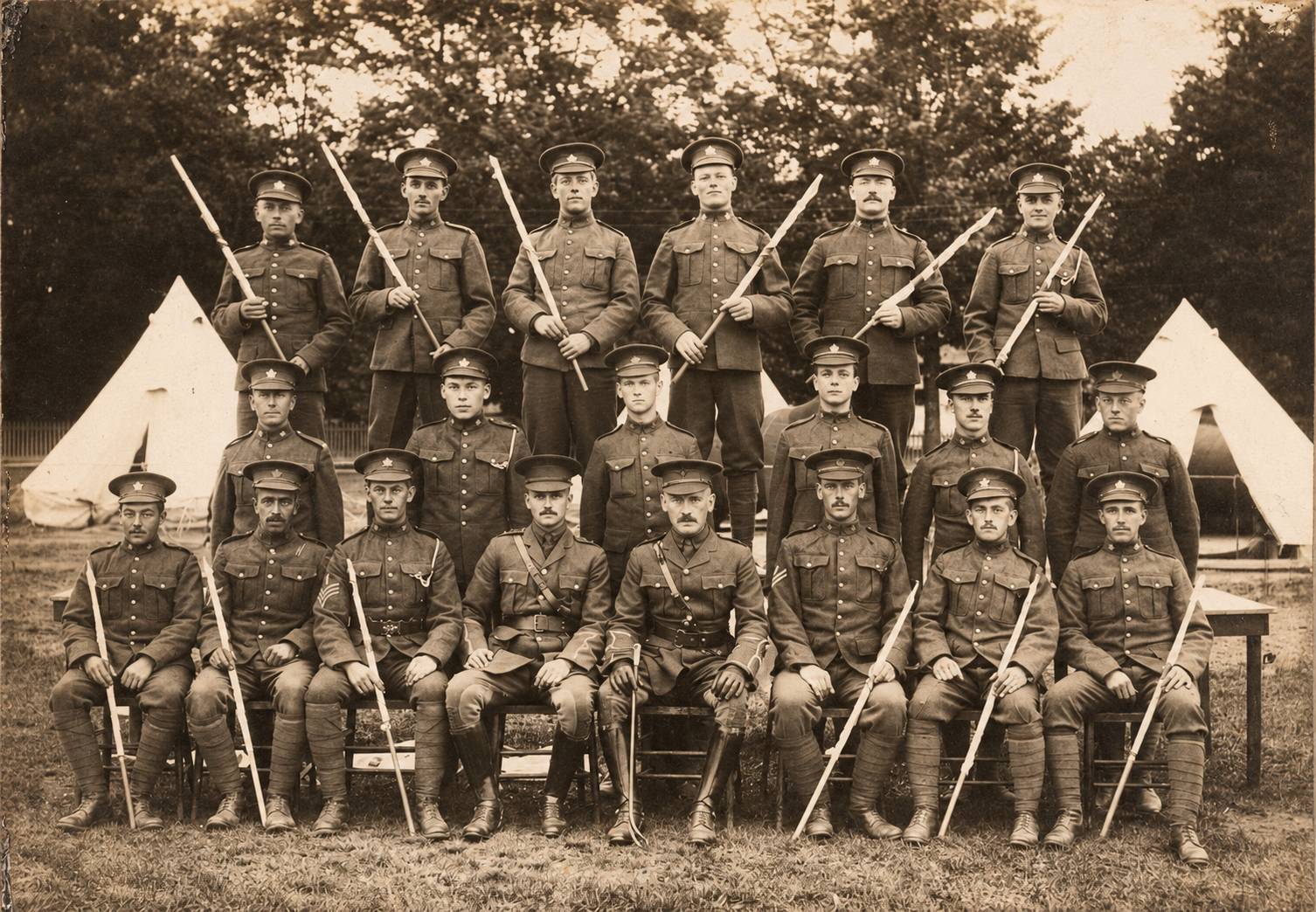
During the Great War (later renamed World War One), more than 66,000 Canadian soldiers died in what many consider a conflict over ill-considered alliances and strategic attrition. Canada’s contributions have grown in importance as researchers take a second, or third, look at how our nation’s military performed in various battles.
During the Great War, Niagara was crucial to the nation’s military efforts, providing training bases, hosting international diplomats, manufacturing war goods, and enhancing wartime security. Canada’s Military District #2 completed training at Niagara Camp in Niagara-on-the-Lake, a military reserve since 1871. In 1914 alone, Fort George Military Reserve (the Commons) prepared over 14,000 soldiers of the 2nd Division of the Canadian Expeditionary Force for battlefield conditions. Many later served at famous sites like Vimy Ridge and Passchendaele.
Thomas Cunningham Daly, born in Glasgow, Scotland, in 1899, came to Canada around age ten. When the war began, he was 15, but in 1916, he lied about his age to join the 159th Battalion. Claiming a birthdate in 1897, Daly signed an attestation sheet with accurate information about his birthplace, place of residence, his mother’s name, and her address. He even gave the correct birthdate, but not the correct year. Why? Like many young men of his age, he found the romantic idea of travel, fighting in a war, and having stories to tell for the rest of his life irresistible. A desire to prove his commitment to a new nation, the promise of defending democracy, defeating a common enemy, and being part of something larger than himself may have added enticement. Whatever motivated young Thomas, he was not unusual or alone. Daly’s decision led him to England in late 1916, where he hoped to join the RAF. However, the 159th was disbanded into the 8th Reserve Battalion, and individual soldiers were transferred to frontline infantry battalions in France or Belgium. He later settled in Fort Erie, where one of his children, Margaret, married a local butcher and had three children, one of whom was this writer. Poppy’s story, like those of many men from Niagara, followed a familiar pattern and deserves recollection, especially when we set aside time to reflect on the contributions of those who came before us.
Niagara’s soldiers fought in many important campaigns, but six of the most famous have been well documented, made into movies, written about in books, and studied by military historians for decades. It would be worthwhile to chronicle those pivotal crusades that determined the outcome of a war no one really wanted. When all was said and done, more than 30 nations declared war, and the conflict drew in over 100 countries from nearly every continent. Having begun because a Serbian nationalist assassinated Archduke Franz Ferdinand in Sarajevo, the local crisis spiralled into a global conflict because of militarism (a fierce and massive arms race between nations like England and Germany), alliances (one nation’s actions would commit many others), imperialism (the competition for wealth, land, and resources), and nationalism (desire for national pride and self-determination created a “powder keg” in Europe). Young men and women from Niagara ended up on the front lines, fighting, nursing, and helping Canada establish its national reputation apart from the mother country.
Battle of the Somme (July 1 – Nov 18, 1916)
Fought in northern France on the upper reaches of the Somme River, this battle was a French and English offensive. It was one of the largest and bloodiest battles in history, with over one million casualties. Some of Niagara’s finest made contributions, including Private James Munroe Franklin, one of the first Black Canadians killed in World War One. Franklin, born in Mississippi, enlisted at 15 after lying about his age. Transferred to the 4th Battalion, he died at the Somme on October 8, 1916, just four days before his 17th birthday.
Private Charles Thompson’s letters home document the “battle hell” of the Somme. Thompson died of his wounds in the first weeks of the conflict. Another contributor was Sergeant-Major Charles Edward Little, who saw intense action at Ancre Heights on October 8, 1916, but survived and was later commissioned as a lieutenant. Harold George Budd crossed the ocean on the same boat as my grandfather (Empress of Britain) and went straight into the trenches, fighting throughout the Somme offensive.
"*" indicates required fields
Battle of Vimy Ridge
A historic battle considered a turning point in the war. Niagara soldiers fought as part of a Canadian corps that, against the odds, captured a heavily fortified ridge. At Drummond Hill Cemetery, Louis Guillou, an assistant undertaker, enlisted in early 1916. His letters home described the horrific conditions in the trenches. He was killed on the first day of the battle, April 9, 1917. Over 200 Niagara volunteers served in the 4th Battalion, which faced fierce battlefield conditions in the first wave at Vimy, suffered many casualties, and helped capture key German strongholds.
Battle of Passchendaele
A mud-drenched trench campaign fought in Belgium, our Niagara soldiers helped capture a ridge at a substantial cost in lives. Having been absorbed into frontline units, our Niagara soldiers fought through the worst of the Flanders muck and mud. Lt. Col. Frederick Hill from Niagara Falls contributed notably. Hill, born in Welland in 1866, was a rare combatant who survived the harsh conditions. A mining explosion killed Private Kenneth Duncan Barnett. The young soldier, born in Niagara Falls, had enlisted in the 1st Battalion (Ontario Regiment). The Passchendaele Archives lists six privates (Thomas Alfred Butterfield, Samuel Chesney, Ernest William Hare, George Augustus Leach, William Harvey Smith, and James Francis Valliquette), Sergeant Thomas Grieve and Lieutenant Allan Herbert Donald Lyon as having fought in the Ypres/Passchendaele operations.
Battle of Amiens
This surprise attack, which is regarded as a turning point in the war, involved hundreds of soldiers from Niagara and saw 100,000 Allied troops relocated overnight to break through German defences, advancing 12 km in just one day. A German military leader called August 8, 1918, “the black day of the German army.” This battle began the 100-day offensive that preceded the November 1918 armistice.
Battle of Arras & Canal du Nord
Fought in September and October, these battles broke the back of the German army but came at an immense cost to Niagara families. Between Arras and Canal du Nord, the Canadian corps suffered over 20,000 casualties, and dozens of names can be found on cenotaphs in Niagara Falls, Welland, Grimsby, and St. Catharines because of the intense warfare endured to bring the conflict to an end. Arras was launched as a night assault at 3 AM in monsoon-like conditions, while local infantry from the 4th and 58th battalions suffered massive injuries and deaths. The Lincoln and Welland Regiment earned honours at both battles.
Battle of Cambrai
While Niagara’s soldiers missed the first battle of Cambrai fighting at Passchendaele, our men left their mark at the second battle of Cambrai (October 8-11, 1918). The 3rd Canadian Division gingerly avoided booby-trapped streets as it liberated Cambrai. Once again, the Lincoln and Welland Regiment earned a battle honour on its regimental colours. Sadly, many of the soldiers who had survived the Somme, Vimy, and Passchendaele lost their lives at Cambrai, just a month before the settlement that ended the war.
In the hundred years since, Niagara has made many valuable contributions preserving Canada’s liberty, defending our homeland, and promoting peace worldwide. The Canadian military has never shirked its duty, turned from its nation’s call, or delayed its commitment to resolving injustices. We will remember them today as we always have, knowing that some will be forever young, having not died in vain, but to keep our land strong and free.

