Niagara’s 32-member regional council says goodbye as 13-member council takes shape
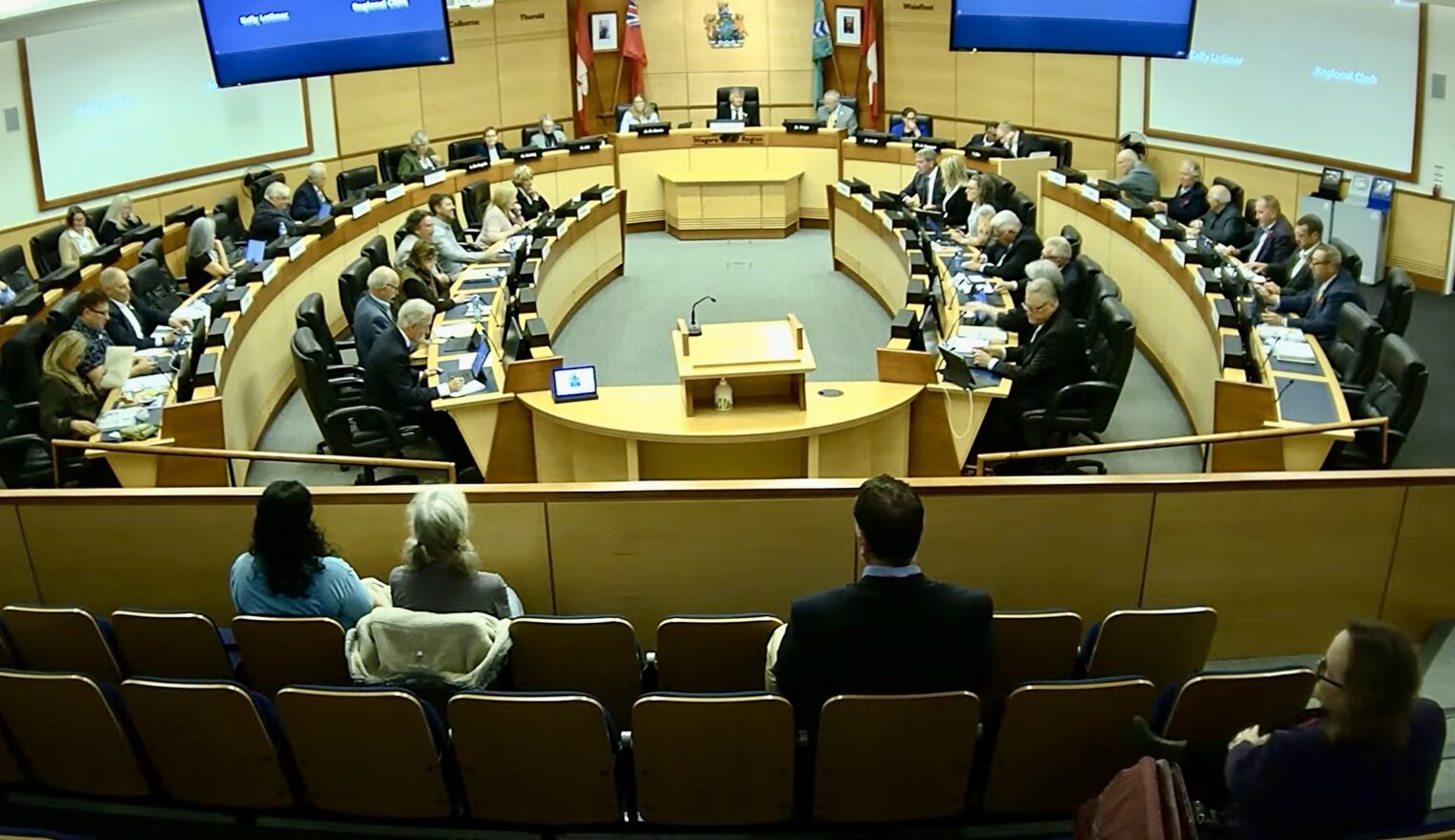
For nearly 50 minutes Thursday night, Niagara regional councillors took turns saying goodbye and telling the people who will replace them what still needs doing.
The November 5th meeting was the last for Niagara’s 32-member regional council. When the new term begins November 15th, the council will consist of the mayors of Niagara’s 12 municipalities and a provincially appointed chair. The change, made under Ontario’s Better Regional Governance Act, 2026, eliminates the seats voters previously filled through separate regional councillor races.
Acting regional chair and Pelham Mayor Marvin Junkin began by congratulating the winners of the October 26th municipal election and thanking everyone who put their name on a ballot. He compared waiting for the final returns in his own close race to waiting for rain on the farm. Then he invited councillors to speak, telling some it would be their last time around the chamber’s horseshoe.
Niagara Falls Coun. Barbara Greenwood said the incoming council had an opportunity to set an example for the province. She also asked the mayors to keep the voices of their individual communities in mind as they take on decisions affecting all of Niagara.
“The weight of representing the entire region now falls on fewer shoulders,” Greenwood said.
I will hound you about homelessness and about addiction, and I will stay focused on that till the day I die.
Grimsby Coun. Michelle Seaborn said she expected the mayors to look out for their own municipalities while weighing what was best for the region. Lincoln Coun. Rob Foster, who spent 26 years on town and regional councils, urged the mayors to call on departing members for advice.
“There’s a lot of deep knowledge and understanding that’s walking out the door with this,” Foster said.
Housing and household costs
Outgoing Niagara-on-the-Lake Lord Mayor Gary Zalepa said he was struck, when he first joined regional council, by how directly its services affected people’s lives. He singled out Niagara Regional Housing as work that mattered to him and called for a new national funding model to help build homes for people most in need.
"*" indicates required fields
Zalepa said the Region’s housing master plan gives the next council concrete projects to advance. He said he would be watching to see whether the mayors and the new administration could make the case for a funding agreement involving Ottawa, Queen’s Park and local governments.
“We just need a new national deal,” Zalepa said.
Welland Coun. Leanna Villella, who spent eight years on Niagara Regional Housing, thanked residents for sending her to the Region and praised the staff who helped her learn the job. She told the returning members they could still expect to hear from her about two issues that had occupied much of her time in office.
“I will hound you about homelessness and about addiction,” Villella said. “And I will stay focused on that till the day I die.”
She ended by congratulating fellow Welland regional councillor Pat Chiocchio on his election as the city’s next mayor. He will return to the regional table in that role.
St. Catharines Coun. Peter Secord asked incoming members to remember the people they had met on doorsteps during the campaign as they face difficult budget decisions. He described households putting off small purchases or repairs and urged the mayors to keep those residents in mind when making decisions.
Secord said he often waited for others to speak at council because their observations changed the questions he wanted to ask. He had expected to spend his first couple of years at the Region learning the job. Four years in, he said, there was still more to learn.
From the public podium to the council table
St. Catharines Coun. Sal Sorrento recalled coming to the chamber around 2017 to advocate on long-term care hours at Linhaven, years before he had a seat at the table. He said he was “shaking like a leaf” the first time he stood at the podium.
Sorrento thanked the staff he had worked with and said he hoped to keep working with them because regional services still mattered to the people he serves in St. Catharines. He also acknowledged colleagues who had lost their election races, saying his own record of five losses and four wins taught him how those defeats feel.
Outgoing Fort Erie Mayor Wayne Redekop, who served six terms over two stints, questioned how much time the mayors would have to take on regional work and where residents would turn with fewer elected representatives at the Region.
“I don’t think it appreciates the fact that it reduces the access points for members of the public to elected representatives,” Redekop said of the reduction.
He also raised concerns about giving additional powers to an appointed chair. Under the weighted voting proposal discussed by the province, he warned, a few municipalities and the chair could end up making decisions that affect all of Niagara. Ontario’s legislation gives the municipal affairs minister authority to set weighted voting rules for upper-tier municipalities.
Regional CAO Ron Tripp said the Region had completed or advanced all 37 actions in council’s strategic plan. He also recalled the death of regional chair Jim Bradley, an unexpected loss during a term that brought difficult budget decisions.
The formal business that followed was brief. Council approved the minutes of its September 24th meeting, and no member asked to go into closed session to discuss a confidential preliminary ombudsman’s report. Junkin adjourned the meeting shortly after the livestream reached one hour and 18 minutes.